Does Replacing a Phone Motherboard Change the IMEI?
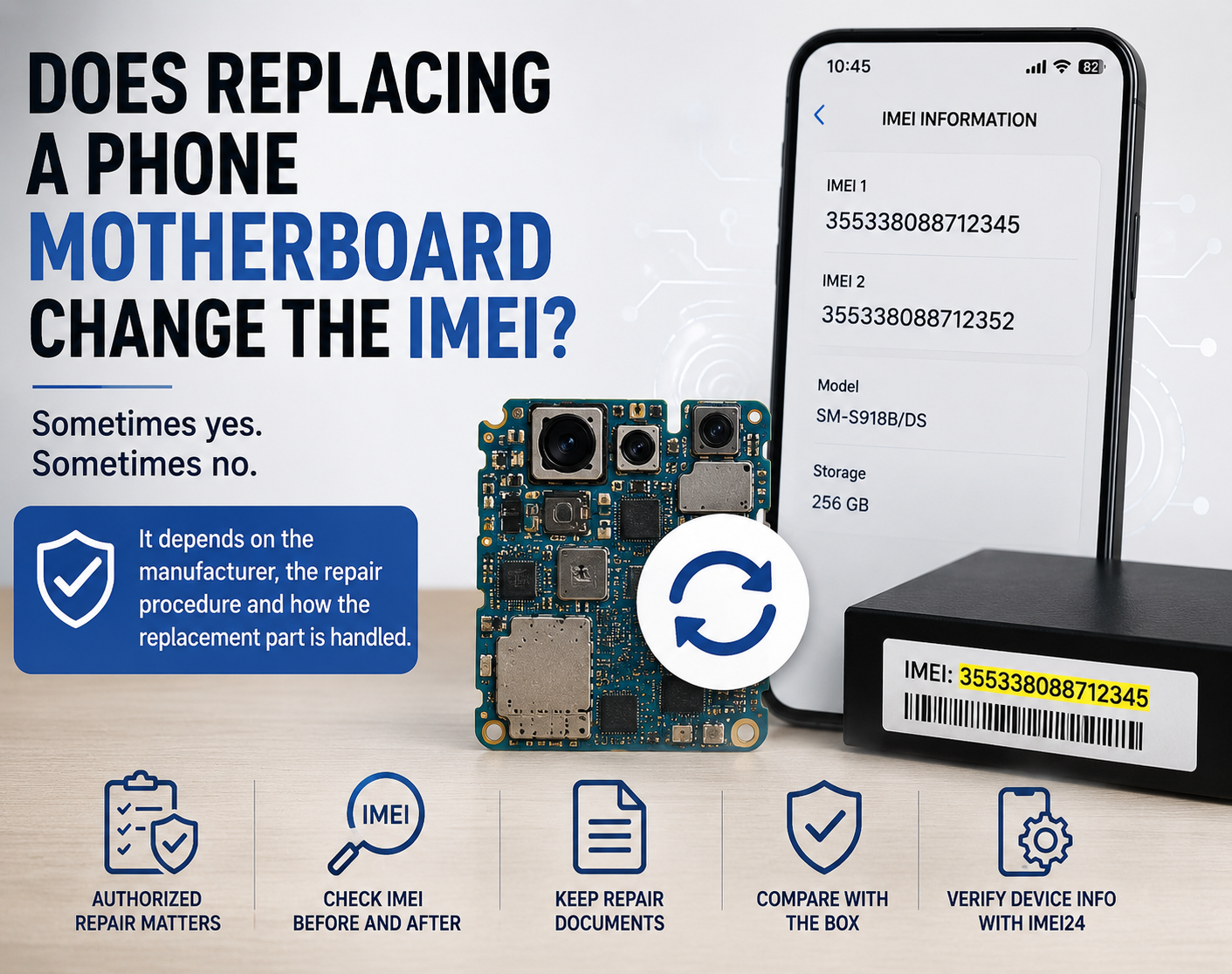
A phone suffers serious damage and the repair shop says the motherboard needs to be replaced. After the repair, you check the device information and notice something interesting - the IMEI may be the same as before.
Or, in another case, it may be different.
So which result is correct?
The answer is less obvious than it seems. Replacing a smartphone's motherboard does not automatically mean that the IMEI must change. What happens depends on the manufacturer, the repair procedure and how the replacement part is handled by the service system.
Why people assume the IMEI must change
The motherboard is one of the most important components inside a smartphone. It contains the processor, storage, cellular hardware and many other components responsible for the phone's operation.
Because the IMEI is used to identify a device on cellular networks, it is easy to assume that replacing the main board automatically creates a completely new device identity.
In practice, authorized repair procedures can be more complicated.
Manufacturers may have systems that associate replacement components with the original device or preserve the device's identification information during an approved repair.
That means a motherboard replacement and an IMEI change are not necessarily the same thing.
Samsung provides a good example
Samsung support has previously confirmed through its official Samsung Members support channel that the IMEI can remain the same after a motherboard replacement.
This is important because it shows why simple rules such as "new motherboard equals new IMEI" are unreliable.
An authorized repair can follow manufacturer procedures that are very different from simply taking a motherboard from another phone and installing it.
The repair documentation therefore matters.
What about an iPhone?
Apple treats the logic board as a major component of the iPhone.
On supported models and iOS versions, Apple can display information about important replaced parts in Parts and Service History.
Apple also warns that a previously used logic board may be identified as an unverified part in certain situations.
This means that modern phones increasingly keep track of major component replacements independently from the simple question of what IMEI is currently displayed.
A phone can therefore have a repair history involving an important internal component while still requiring additional information to understand exactly what was replaced and how the repair was performed.
The IMEI printed on the box may become important
After a major repair, it is worth comparing several sources of device identification.
You can check:
* the IMEI displayed in the phone settings
* the IMEI shown after entering *#06#
* the IMEI printed on the original packaging
* the IMEI written on repair documentation
If these numbers do not match, do not immediately assume that something illegal or suspicious has happened.
There may be a legitimate repair history behind the difference.
However, it is a good reason to ask for documentation.
A motherboard taken from another phone is a different situation
There is an important difference between an authorized motherboard replacement and installing a complete used board taken from another device.
A donor motherboard may already have its own device identity and repair history.
This is one reason why buying heavily repaired smartphones can be more complicated than buying devices that have only had a screen or battery replacement.
The phone may look perfect from the outside while its internal history is much more complicated.
If a seller says that the motherboard was replaced, ask:
* Who performed the repair?
* Was it an authorized service center?
* Is there an invoice or repair report?
* Was a new or previously used component installed?
* Does the current IMEI match the repair documentation?
These questions are much more useful than assuming that every motherboard replacement is automatically a problem.
Why checking the current IMEI still matters
After a major repair, the IMEI currently reported by the phone becomes an important reference point.
Using IMEI24 can help you identify information available for that device, such as the exact model, Product Name, manufacturer, storage, SKU, regional variant or blacklist status where supported.
This does not tell you the complete repair history.
An IMEI check cannot reliably tell you every component that was replaced or every repair performed during the phone's lifetime.
But it can help answer a different question:
Does the identity currently reported by the phone make sense for the device in front of you?
That can be useful when checking a repaired or second-hand smartphone.
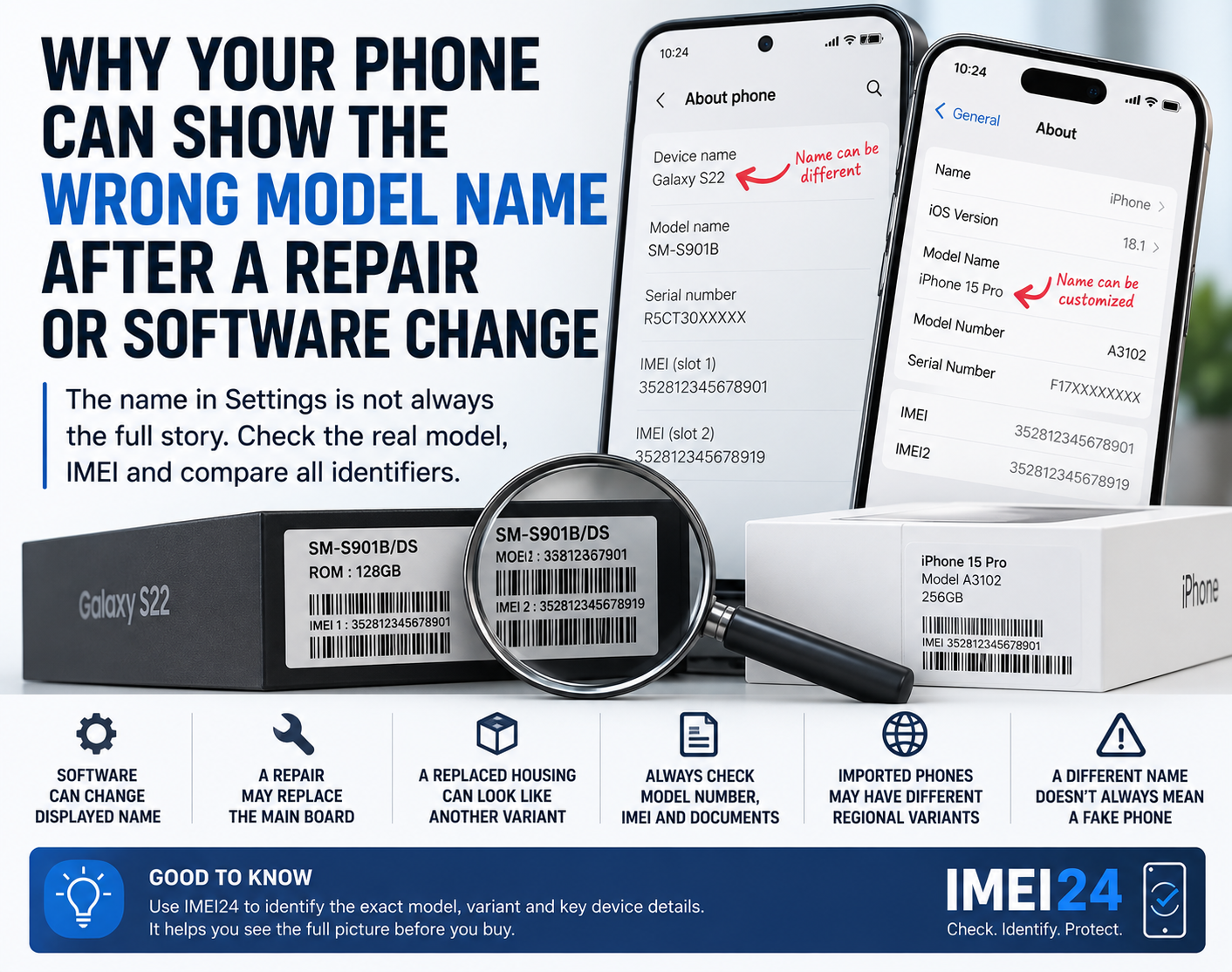
What if the model information does not match?
Suppose you are buying a phone advertised as one particular regional version, but the current device information points to something different.
That deserves further investigation.
Possible explanations can include:
* an incorrect listing
* a replaced motherboard
* a donor device used during repair
* a different regional variant
* incorrect assumptions about the original phone
The important point is not to jump immediately to conclusions.
Use the information as a reason to ask better questions.
Repair documents can be more valuable than a perfect-looking phone
A professional repair is not automatically a disadvantage.
A smartphone with a properly replaced motherboard from an authorized service center may be a better purchase than a phone with hidden liquid damage that has never officially been repaired.
The problem begins when the repair history is unclear.
For an expensive used phone, documentation can tell you:
* when the repair happened
* which service center performed it
* what component was replaced
* which IMEI was associated with the repair
This is particularly useful when there is a difference between the IMEI on the original box and the one currently reported by the device.
Should you avoid every phone with a replaced motherboard?
Not necessarily.
A motherboard replacement can be a legitimate repair for a serious hardware failure.
What matters is how it was performed and whether the current device identity can be explained.
Before buying such a phone:
* verify the current IMEI
* check the exact model and variant
* check blacklist status where available
* compare the IMEI with the box and documents
* ask for the repair invoice
* test cellular connectivity
* test Wi-Fi, Bluetooth, cameras and biometric functions
* make sure there are no warnings about important components
A lower price can make a professionally repaired device attractive, but the discount should reflect the phone's history.
The simple answer
Does replacing a motherboard change the IMEI?
Sometimes the device identification may change, but a motherboard replacement does not automatically mean that it must.
Authorized manufacturer procedures can preserve or correctly associate the phone's identity with the repaired device.
That is why the most useful approach is not to rely on one rule.
Check the IMEI currently reported by the phone, compare it with available documentation and understand what type of repair was actually performed.
With major smartphone repairs, context is often more important than the number alone.